

If you were arrested for DUI in Georgia after an officer scored “clues” on the Horizontal Gaze Nystagmus (HGN) eye test, prosecutors will often treat those clues as scientific proof of impairment. They should not get a free pass.
The Kansas Supreme Court put the reliability problem in plain language in City of Wichita v. Molitor, 301 Kan. 251 (2015):
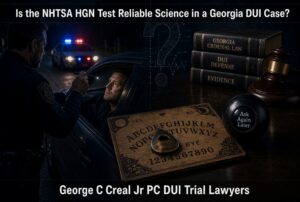
Granted, as suggested above, reasonable suspicion can be established with evidence that is less reliable than that which is required to establish guilt beyond a reasonable doubt or even to establish probable cause. But there is a threshold level of reliability that must be met. One must show that any proffered evidence that is ostensibly based upon scientific principles does, in fact, have some credible correlation to the matter that must be proved. For instance, consider the hypothetical scenario of an officer who testified that the officer had undergone extensive training in the operation of a Ouija Board; that when a Ouija Board is asked if the driver being tested is DUI, the Board’s arrow will point at “yes” or “no”; that random sampling has shown that the Ouija Board correctly identifies when a driver’s intoxication exceeds the legal limit 60% of the time; and that the Board’s arrow pointed at “yes” when asked if Molitor was DUI. Should a court allow the officer to base reasonable suspicion upon the Ouija Board test results? Of course not. And at this point in the state of Kansas, the HGN test has no more credibility than a Ouija Board or a Magic 8 Ball.
Kansas is not Georgia. But the principle is the same: if the State offers a test as science, the test has to have a real correlation to the fact it is supposed to prove. “The officer was trained” is not enough.
What officers claim the HGN proves
NHTSA trains officers that alcohol causes an involuntary jerking of the eyes as they follow a stimulus. The officer scores up to six clues (three per eye): lack of smooth pursuit, distinct nystagmus at maximum deviation, and onset of nystagmus before 45 degrees. Four or more clues, NHTSA says, indicate a BAC of 0.08 or more.
That claim is sold as validated science. In the field it is a roadside estimate of angle, speed, and “jerkiness,” often at night, on a roadside, after a crash or a traffic stop, by an officer who already suspects drinking.
 Georgia law is more welcoming than Kansas—but it is not a blank check
 Georgia law is more welcoming than Kansas—but it is not a blank check
Georgia historically treated HGN as scientific evidence that had reached “verifiable certainty” under the old Harper standard. Hawkins v. State allowed HGN as a basis for an officer to say a driver was impaired by alcohol, without a full scientific hearing in every case, if the officer substantially followed accepted procedures.
That does not mean HGN can do whatever the State wants:
- An officer generally cannot translate HGN clues into a specific numeric BAC without a proper scientific foundation. The Georgia Supreme Court made that clear in Spencer v. State.
- The State still has to show the test was substantially performed in an acceptable manner. Serious deviations—glasses left on, no medical screening after a wreck, rushed timing, stimulus held too high or too close—can support exclusion. See Walsh v. State and later administration cases.
- Since July 1, 2022, O.C.G.A. § 24-7-702 applies the Daubert reliability standard in criminal cases. Recent Georgia authority treats HGN as scientific evidence subject to gatekeeping, unlike the walk-and-turn and one-leg-stand tests, which courts have treated as non-scientific lay observations. That distinction matters on a motion to exclude.
In other words, Georgia has not adopted the Kansas “Ouija board” holding. It has also not made HGN immune from challenge.
The reliability problems NHTSA does not advertise at the roadside
Even if a court admits HGN, the weight of the evidence is another fight. Common problems include:
- Nystagmus has many non-alcohol causes: fatigue, migraine, inner-ear issues, certain medications, nicotine, caffeine, congenital nystagmus, and even how far the eyes are turned to the side.
- NHTSA’s own robustness research, when scored the way officers are actually trained (four or more clues, 0.08 threshold), has been shown by critics—including analysis posted on this site—to produce very high false-positive rates in control subjects below 0.08. Published conclusions of “robustness” often depend on moving the scoring rules after the fact.
- Laboratory accuracy claims assume a correctly administered test. Field studies and video evidence routinely show officers changing stimulus height, distance, speed, or timing. NHTSA itself says changing a standardized element compromises validity.
- HGN was developed and marketed as a BAC screening tool. It is a weak proxy for “less safe to drive.” Correlation with a number on a breath machine is not the same thing as proof of impaired driving.
That is the Molitor point. A test can look official, come with a manual, and still fail the threshold of having a credible scientific correlation to the legal issue.
What this means if you are charged in Georgia
Do not assume “six of six clues” ends the case. Ask:
- Was the stop and the request for field tests lawful?
- Did the officer medically screen you and follow NHTSA protocol on video?
- Is the State trying to turn eye jerks into a BAC number?
- Under Daubert, has the State actually shown reliable application of a reliable method in your conditions—not just that some 1970s or 1990s study exists?
Field sobriety tests in Georgia are voluntary. The HGN is the one courts still treat as “science.” That is exactly why it has to be attacked as science: foundation, administration, error rate, alternative causes, and overclaiming.
Talk to a Georgia DUI trial lawyer who tries these issues
George C. Creal, Jr., P.C. defends DUI cases across metro Atlanta and Georgia. If HGN is part of the State’s case against you, call 404-333-0706 or visit www.georgecreal.com for a free case evaluation.
This post is general information, not legal advice for any specific case. Outcomes depend on the facts, the video, the officer’s training, and the judge.