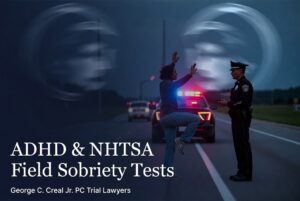
How ADHD Can Lead to False Positives on NHTSA Standardized Field Sobriety Tests in Georgia DUI Cases
If you have ADHD and were arrested for DUI in Cobb County or Metro Atlanta after performing poorly on field sobriety tests, you are not alone. Many people with Attention-Deficit/Hyperactivity Disorder are stopped, asked to perform the National Highway Traffic Safety Administration (NHTSA) Standardized Field Sobriety Tests (SFSTs), and arrested — even when they are completely sober.
The problem is that ADHD symptoms can closely mimic the signs of impairment that officers are trained to look for.
What Are the NHTSA Standardized Field Sobriety Tests?
NHTSA has validated three tests that Georgia officers commonly use during DUI investigations:
Horizontal Gaze Nystagmus (HGN) – The officer moves a stimulus in front of your eyes and looks for involuntary jerking.
Walk-and-Turn (WAT) – You walk heel-to-toe in a straight line, turn, and walk back.
One-Leg Stand (OLS) – You stand on one leg while counting out loud.
These tests are designed as divided attention tests. They require you to listen to instructions, remember them, maintain balance, and perform physical tasks at the same time. This is exactly where ADHD can create significant problems — even when no alcohol or drugs are involved.
How ADHD Affects SFST Performance
Here’s how common ADHD symptoms can lead to “clues” of impairment:
Inattention & Distractibility People with ADHD often struggle to maintain focus during long instructions. On the Walk-and-Turn and One-Leg Stand, this can result in starting too early, stopping, missing steps, or forgetting the count — all counted as clues by officers.
Impulsivity ADHD can cause someone to begin a test before the officer finishes giving instructions or to turn incorrectly. These behaviors are scored as impairment clues.
Hyperactivity & Restlessness Difficulty standing still, swaying, or using arms for balance (even slightly) can appear on the One-Leg Stand and Walk-and-Turn.
Oculomotor Differences Research shows that some individuals with ADHD have differences in eye movement control, including issues with smooth pursuit and saccades. While this does not typically produce the classic alcohol-related nystagmus, it can complicate HGN interpretation.
Anxiety & Performance Pressure The stress of a traffic stop can worsen ADHD symptoms, leading to even poorer performance on tests that require calm focus and coordination.
Because NHTSA’s original validation studies were conducted primarily on subjects without neurological conditions like ADHD, the tests were never properly calibrated for these individuals.
Why Officers Often Miss ADHD
NHTSA training instructs officers to ask about medical conditions, injuries, or disabilities before administering SFSTs. In practice, many officers:
Fail to ask these questions thoroughly
Do not document medical conditions when disclosed
Interpret ADHD-related behaviors as signs of impairment
This creates a serious risk of false positives — sober drivers with ADHD being arrested for DUI.
Legal Implications in Georgia DUI Cases
Under Georgia law (O.C.G.A. § 40-6-391), the State must prove you were under the influence to the extent it was less safe to drive. Poor performance on field sobriety tests is often used to establish probable cause for arrest and as evidence at trial.
However, when a driver has ADHD (or another medical condition), an experienced DUI defense attorney can argue that:
The SFST results are unreliable due to the driver’s neurological condition
The officer failed to properly account for medical factors
There is insufficient evidence of actual impairment
In some cases, this can lead to suppression of the field sobriety test evidence or even dismissal of the charges.
How George C. Creal Jr. PC Can Help
At George C. Creal Jr. PC Trial Lawyers, we have extensive experience handling Georgia DUI cases involving medical conditions, including ADHD. We know how to:
Obtain and present medical records and expert testimony
Cross-examine officers on their failure to consider ADHD
Challenge the reliability of SFSTs when neurological conditions are present
Fight for reduced charges or dismissal when the evidence does not support impairment
If you have ADHD and were arrested for DUI after field sobriety testing, the tests may not have been a fair measure of your ability to drive.