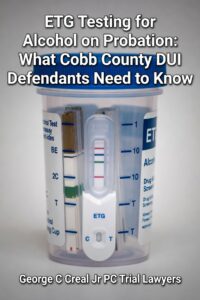
ETG Testing for Alcohol on Probation: What Cobb County DUI Defendants Need to Know
If you’re on probation in Cobb County after a DUI conviction, understanding ETG testing (also called ethyl glucuronide testing) is critical. Many clients come to me surprised when a random urine screen detects alcohol days after they last drank. ETG testing is one of the most common tools probation officers use in Georgia to enforce alcohol abstinence—and failing it can trigger a probation violation and possible jail time.
Here’s a clear, practical guide to what ETG is, how it works, and how to stay compliant while on probation in Cobb County.
What Is ETG?
ETG stands for ethyl glucuronide. It is a direct metabolite (breakdown product) of ethanol—the type of alcohol found in beer, wine, and liquor. When you drink alcohol, your liver processes it and produces ETG, which is then excreted in your urine (and other body fluids).
Unlike a standard breathalyzer or blood test that only detects alcohol while it’s still in your system (usually a few hours), an ETG test can detect recent alcohol consumption long after you’ve sobered up. This makes it ideal for monitoring abstinence in probation, DUI Court, and treatment programs.
How ETG Testing Works in Cobb County Probation
In Cobb County, probation conditions for DUI cases typically include:
Random urine drug and alcohol screens
A standard drug panel plus ETG for alcohol
Witnessed collection (the officer or lab staff watches you provide the sample)
Cobb County specifically notes that ETG tests detect alcohol use for up to 72 hours. Many labs and programs use a detection window of up to 80 hours (roughly 3–4 days), depending on the amount consumed, your metabolism, hydration, and the lab’s cutoff level.
Common cutoff levels include:
100 ng/mL — Highly sensitive (detects even light drinking longer, higher chance of incidental positives)
500 ng/mL — More common in legal/probation settings (focuses on heavier or more recent use)
Cobb County probation also provides clients with an Incidental Alcohol Exposure Form that lists products to avoid or limit. Following this form is essential.
Why Probation Uses ETG Testing
Standard alcohol tests only catch you if you’re currently impaired. ETG testing closes that gap. It helps ensure you’re truly abstaining as required by your sentence. In Cobb County and across Georgia, a positive ETG result on probation is often treated as a violation—even if you feel completely sober and haven’t had a drink in days.
A violation can lead to:
A probation revocation hearing in Cobb County State Court or Superior Court
Important note: Even small amounts of alcohol can trigger a positive at lower cutoffs.
Potential for False Positives from Incidental Exposure
One of the biggest concerns with ETG testing is its sensitivity. You don’t have to drink to test positive. Common sources of incidental alcohol exposure include:
Hand sanitizers (especially alcohol-based)
Mouthwash (Listerine, Scope, etc.)
Cough syrups and cold medicines (NyQuil, etc.)
Aftershave, cologne, or perfumes
Some hand lotions, makeup, or hair products
Vanilla extract or cooking extracts
Certain non-alcoholic beers or kombucha (check labels)
Cleaning products or disinfectants
Cobb County’s incidental exposure form is designed to help you avoid these. Always read labels and ask your probation officer if you’re unsure about a product.
What Should You Do If You’re on Probation in Cobb County?
Abstain completely — This is the only guaranteed way to pass every test.
Follow the Incidental Alcohol Exposure Form exactly.
Avoid high-risk situations — Don’t use alcohol-based hand sanitizer if possible; opt for soap and water or non-alcohol alternatives.
Stay in communication — If you have a legitimate medical reason or concern about a product, document it and discuss it with your probation officer before testing.
Know your rights — You have the right to request confirmation testing in many cases and to be represented at any revocation hearing.
What Happens If You Test Positive?
A positive ETG result does not automatically mean you go to jail. At a probation revocation hearing, we can present evidence such as:
Incidental exposure explanations supported by documentation
Medical conditions that may affect results
Questions about chain of custody or lab procedures
Your overall compliance history
As your Cobb County DUI and probation defense lawyer, I regularly handle revocation hearings and work to minimize or avoid additional jail time when possible.
Bottom Line from Your Cobb County DUI Lawyer
ETG testing is a powerful tool that gives probation officers a much longer look-back period than traditional tests. While it helps enforce sobriety, its sensitivity means innocent exposure can create problems. The safest strategy is complete abstinence and strict adherence to your probation conditions and the incidental exposure guidelines.
If you’re facing a DUI charge, already on probation, or have received a positive ETG test in Cobb County, contact my office immediately. We have extensive experience defending DUI cases and probation violations throughout Cobb County and Metro Atlanta.
Free Case Evaluation Call or text: (404) 333-0706 Or submit your information online at https://www.georgecreal.com/cobb-county-dui-lawyer/
This blog post is for informational purposes only and does not constitute legal advice. Every case is unique. George C. Creal, Jr., P.C. is a Georgia Professional Corporation authorized to practice law in the State of Georgia only.
Stay compliant, stay out of jail, and let us fight for the best possible outcome in your case.