

If you’ve been arrested for DUI in Cobb County or anywhere in Metro Atlanta, you already know how heavily the state relies on blood alcohol concentration (BAC) results from breathalyzers or blood tests. Prosecutors and their toxicologists often use these numbers to argue you were over the legal limit at the exact moment you were driving. But what if the science behind those calculations is flawed?
A new peer-reviewed article published in the Medico-Legal Journal raises serious questions about one of the most common assumptions in forensic toxicology: the so-called “two-hour rule” for alcohol absorption.
The Article: “Extended Absorption, Implications – Rethinking Alcohol Pharmacokinetics in Forensic Calculations”
Written by forensic toxicologist Aaron Olson, the article examines how alcohol is actually absorbed into the bloodstream and why current forensic practices may be overstating BAC levels at the time of driving. Olson reviewed decades of scientific literature and real-world casework, including an analysis of 36 recent retrograde extrapolation reports from a state crime lab. Every single report assumed absorption was complete within two hours of the last drink — with almost no consideration of individual factors that can dramatically extend that timeline.
Article: https://journals.sagepub.com/doi/10.1177/00258172251382701
Why This Matters: Alcohol Absorption Isn’t One-Size-Fits-All
Here’s the key science in plain English:
- Alcohol doesn’t instantly enter your bloodstream the moment you swallow it. It must first be absorbed through the stomach and small intestine.
- Studies show enormous individual variation. Time to peak BAC can range from as little as 12 minutes to more than three hours — and in some cases nearly four hours when alcohol is consumed with a large meal.
- Certain medical conditions (like GERD) and common medications (including GLP-1 drugs such as Ozempic or Wegovy) slow gastric emptying and can push peak absorption out to 3–5 hours or longer.
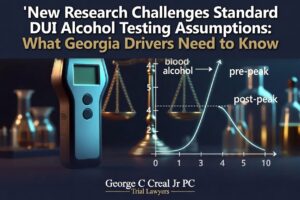
- When someone is still in the absorptive phase, retrograde extrapolation (back-calculating your BAC to the time of driving) will overestimate your actual level at the moment you were behind the wheel.
In other words, the state’s expert may testify that your BAC was 0.10% or higher when you were stopped — but if alcohol was still being absorbed, your true level at the time of driving could have been well below the legal limit of 0.08%.
Breath testing legal paradigms also warrant close scrutiny. Current protocols and statutes typically assume that breath tests are administered after peak alcohol consumption, during the post-absorptive (elimination) phase. However, when a breath test is performed pre-peak — while alcohol is still being absorbed into the bloodstream — breath alcohol levels can be dramatically higher than actual blood alcohol levels. Studies indicate that breath alcohol concentrations can be as much as twice as high relative to venous blood alcohol concentration during active absorption, since breath alcohol more closely reflects rapidly rising arterial blood alcohol.
How This Plays Out in Georgia DUI Cases
- When and what you last ate
- Medications you take
- Medical conditions
- The timing of your last drink relative to the stop and blood draw
…are often ignored or given only lip service.
This new research gives DUI defense attorneys strong ammunition to cross-examine state toxicologists and challenge the reliability of their calculations. It underscores what we at George C. Creal, Jr., P.C. have always believed: every DUI case is unique, and the science must be scrutinized case by case.
Protecting Your Rights in Cobb County and Beyond
At George C. Creal, Jr., P.C., Trial Lawyers, we stay current on the latest forensic science because it directly affects our clients’ outcomes in Cobb County, Fulton, DeKalb, Gwinnett, and across Metro Atlanta. We don’t accept the state’s numbers at face value — we dig into the details, consult with independent experts when needed, and fight to expose weaknesses in the evidence.
If you’ve been charged with DUI, don’t assume the breathalyzer or blood test result is the final word. Scientific advancements like this one can make the difference between a conviction and a dismissal or reduction.
Call our office today at (404) 333-0706 for a free, confidential consultation or check out our website at www.georgecreal.com. We’ll review the specific facts of your case and explain exactly how the latest research on alcohol pharmacokinetics may apply to your defense.
George C. Creal, Jr., P.C. — Fighting for the best possible result in every DUI case throughout Cobb County and Metro Atlanta.